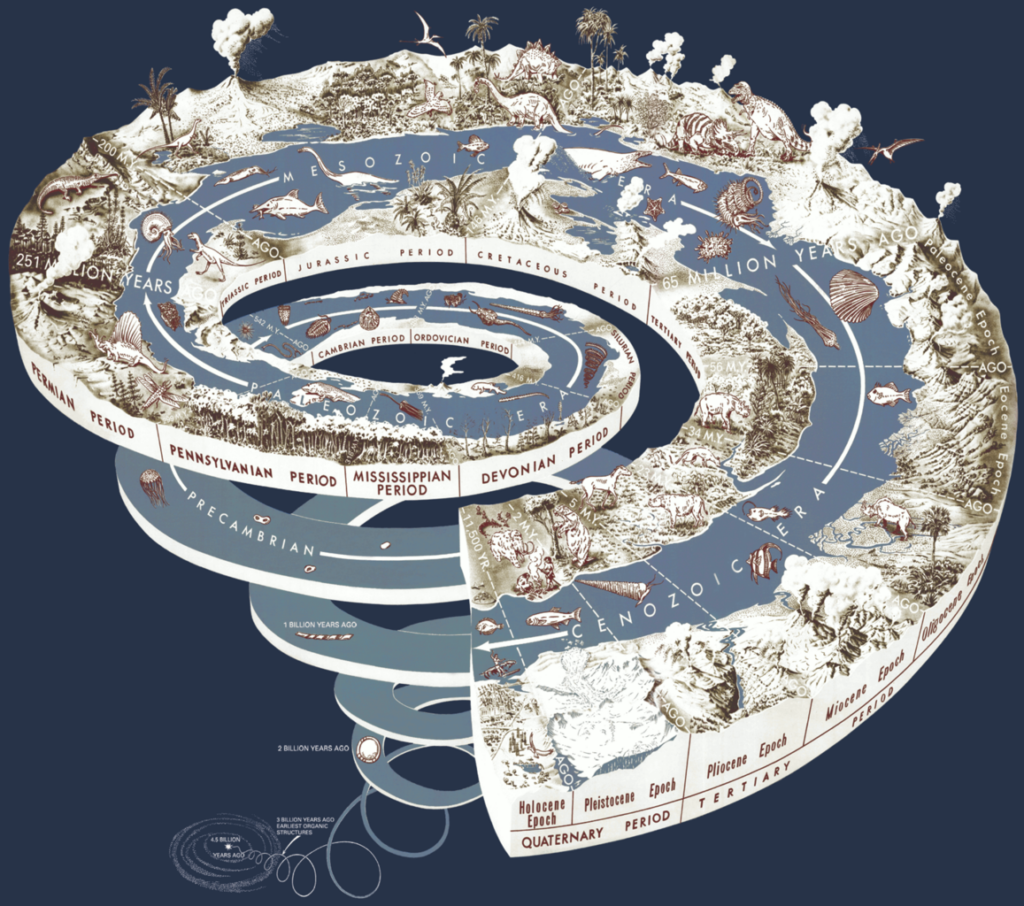
I’m writing a book about the evolution of life across deep time, but with a different emphasis from most accounts. Rather than treating life and Earth as separate stories, I explore them as a single, intertwined system—two partners in a long cosmic dance, each continually reshaping the other.
Life has not simply adapted to Earth; it has transformed it. Early phytoplankton, for example, gradually enriched the atmosphere with oxygen, triggering a cascade of consequences that reshaped the planet, including episodes of global glaciation. At the same time, the absence of an ozone layer meant that early life was confined to the oceans, where water provided protection from harmful ultraviolet radiation. Earth shaped life—and life reshaped Earth—in return.
To tell this story, I divide deep time into four acts:
Star Time – from the Big Bang to the emergence of the conditions that made life on Earth possible.
Microbe Time – early life on earth when life was almost entirely single-celled.
Multicellular Time – from the ‘Cambrian explosion’ where suddenly the fossil record shows the appearance of complex marine life in all its glory: simple fish, an armoured creature like a woodlouse (trilobite) and worms. This period runs up to the emergence of Homo sapiens.
Human Time – our global spread and the growth of culture, up to the invention of writing and the beginnings of recorded history.
Most histories of life begin in Multicellular Time, treating the earlier acts as a brief prelude. I think this misses a powerful narrative opportunity. Each act sets the stage for the next—and in the case of Star Time, lays the foundations not just for life’s evolution, but for life itself.
Outreach Live Session
Alongside the book, I’m developing an interactive teaching session that uses movement and team competition to explore deep time, with the aim of presenting it at the UK Playful Learning Association conference this July.