Deep Time in Four Acts

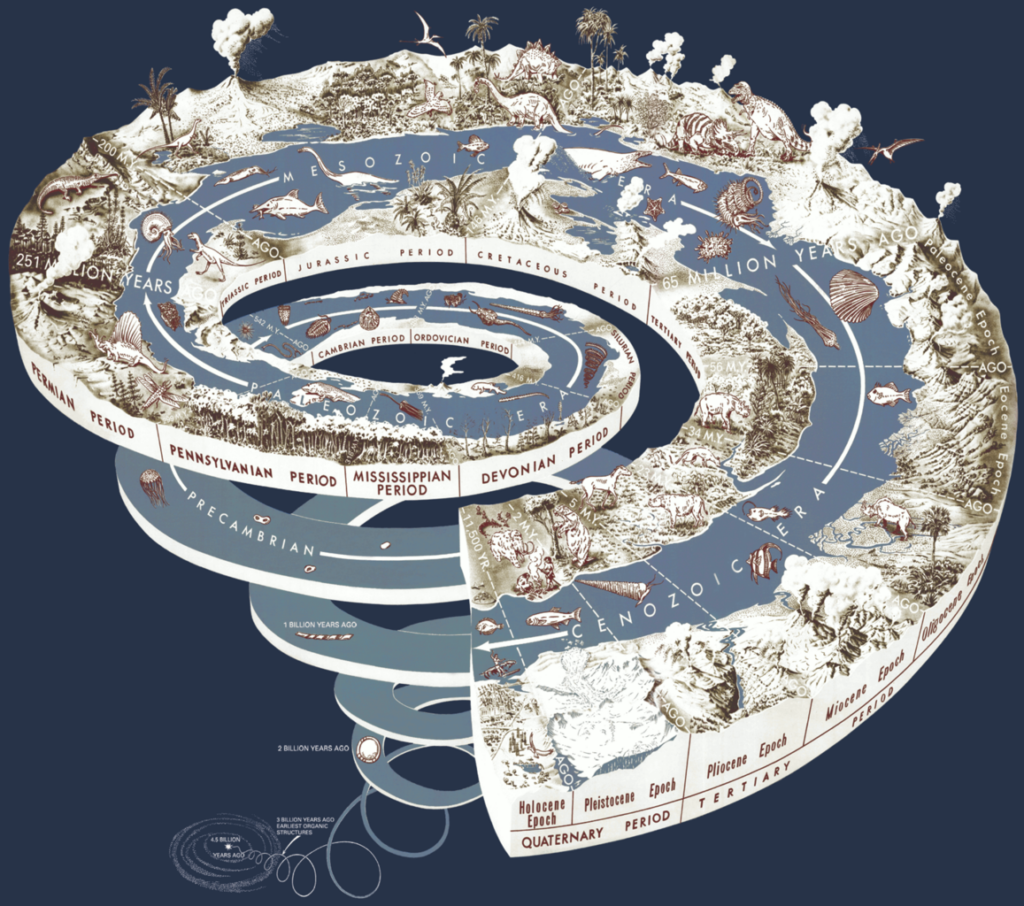
A visual representation of Deep Time from the USGS. Note that the ‘human time’ referenced below is in the Cenozoic era on this graphic: extremely recent in deep time.

I’m writing a book about the evolution of life across deep time, but with a different emphasis from most accounts. Rather than treating life and Earth as separate stories, I explore them as a single, intertwined system—two partners in a long cosmic dance, each continually reshaping the other.

Life has not simply adapted to Earth; it has transformed it. Early phytoplankton, for example, gradually enriched the atmosphere with oxygen, triggering a cascade of consequences that reshaped the planet, including episodes of global glaciation. At the same time, the absence of an ozone layer meant that early life was confined to the oceans, where water provided protection from harmful ultraviolet radiation. Earth shaped life—and life reshaped Earth—in return.

To tell this story, I divide deep time into four acts:

Star Time – from the Big Bang to the emergence of the conditions that made life on Earth possible.
Microbe Time – early life on earth when life was almost entirely single-celled.
Multicellular Time – from the ‘Cambrian explosion’ where suddenly the fossil record shows the appearance of complex marine life in all its glory: simple fish, an armoured creature like a woodlouse (trilobite) and worms. This period runs up to the emergence of Homo sapiens.
Human Time – our global spread and the growth of culture, up to the invention of writing and the beginnings of recorded history.

Most histories of life begin in Multicellular Time, treating the earlier acts as a brief prelude. I think this misses a powerful narrative opportunity. Each act sets the stage for the next—and in the case of Star Time, lays the foundations not just for life’s evolution, but for life itself.


Outreach Live Session

Alongside the book, I’m developing an interactive teaching session that uses movement and team competition to explore deep time, with the aim of presenting it at the UK Playful Learning Association conference this July.
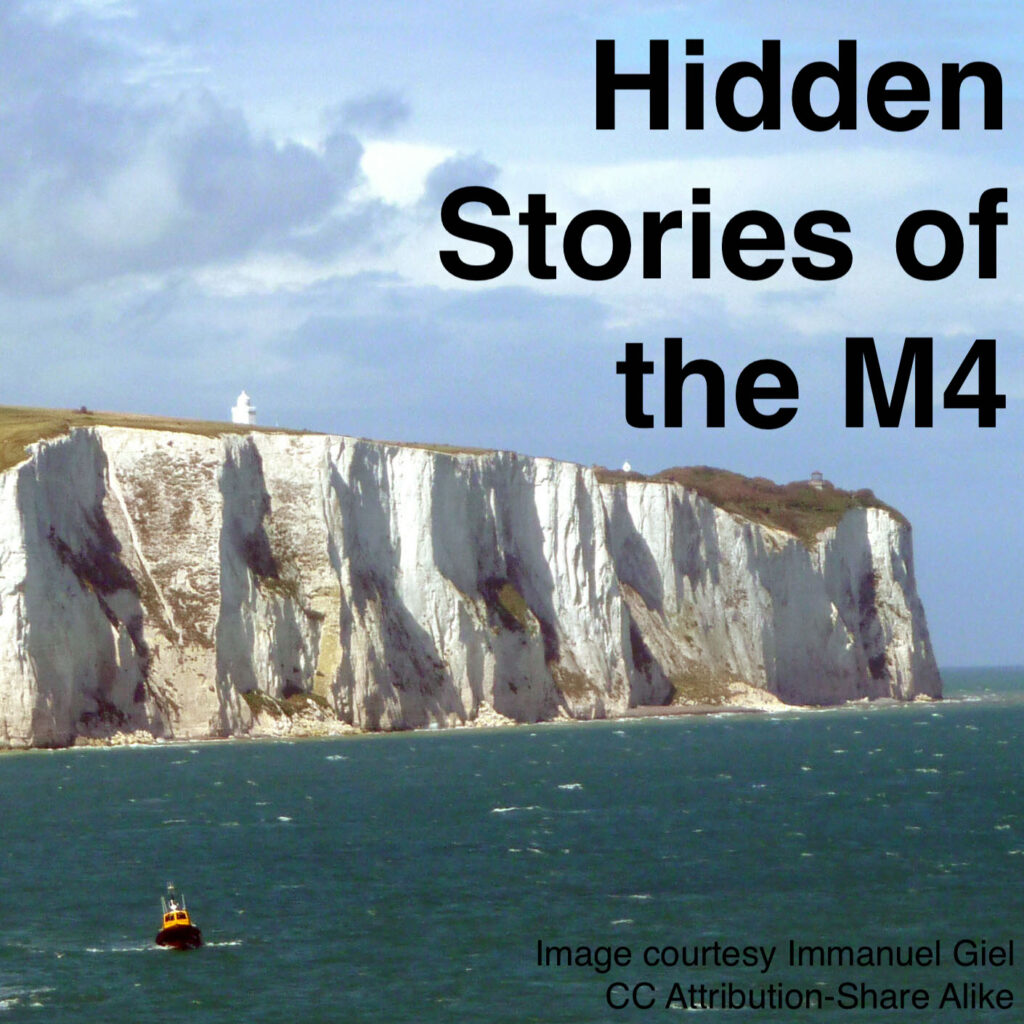
Hidden Stories of the M4

Driving along the M4 is a boring business; the surface landscape, while pleasant enough, is quite forgettable. But below the surface the rocks are far more interesting: as you drive west from London you pass over successively older rocks back through the time of the dinosaurs to the ancient life of earth when animals hadn’t yet left the oceans.

Years ago I was on a boat bobbing around the Portuguese coast on a boat tour looking at fantastic natural caves and arches. I was thinking what a shame it was the locals running the tours weren’t telling us anything about the geological period the rocks came from that had made such amazing formations. It occurred to me that you could have a recorded commentary playing from a loud speaker discussing the geology that played as the boat visited the different sites. And then I realized that you could do the same driving along the M4 as you went junction to junction passing over the different geological periods. I’ve now followed through on my idea and produced three short podcasts for each of the most recent geological periods (Cenazoic*, Cretaceous and Jurassic) in the podcast series “Hidden Stories of the M4”:

Audio player

Feed link https://www.richardtreves.com/feed/podcast/hiddenstoriesm4

(can be put in your podcast player of choice)

You can listen to individual episodes where you like but I designed it to be played as you drive from London west on the M4. The majority of the podcasts are associated with a particular junction and tell you about the rocks underground at each location. The main topics I cover are:

  • Individual stories of geologists who discovered the stories such as Mary Anning from the 19th century, now a celebrated paleontologist (fossil expert) but who received little recognition in her own time.
  • How we’ve used the geology in our buildings
  • History of life including lots about the age of the dinosaurs.

*Actually, this is a geological era not a period but its about as long as the other two.